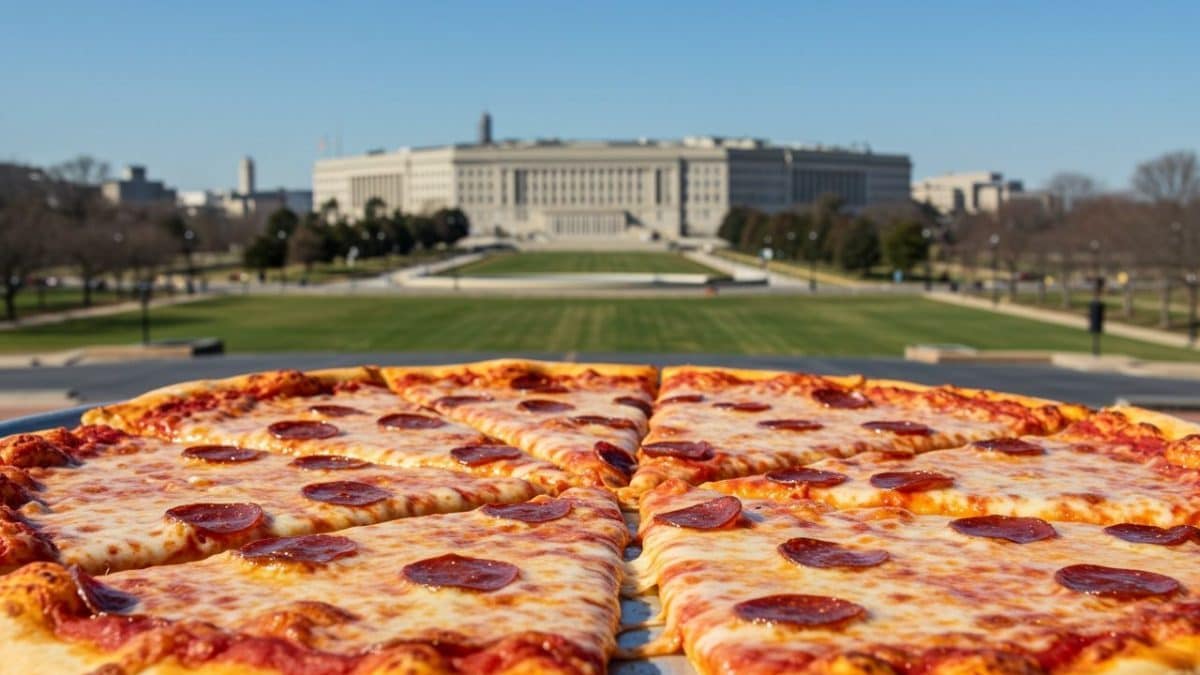
In the world of geopolitical analysis, there are complex indicators, mathematical models, satellite networks, and classified reports. Then there's the Pentagon Pizza Index, which observes one simple, unerringly human thing: how many pizzas are ordered near the Pentagon.
The idea is as disarming as it is seductive: when the machinery of power accelerates, when crises overlap and meetings extend past closing time, some people remain locked in their offices, discussing, analyzing, and deciding. And at a certain point, inevitably, hunger sets in: this is precisely where this unofficial theory comes in, halfway between urban legend and intelligence folklore.
According to the Pentagon Pizza Index, major international events leave their mark not only on financial markets or government announcements, but also in more subtle and decidedly less solemn signals: when a large increase in orders is noted in the area around the Pentagon, it's likely that some very important decisions are about to be made there. But how did this theory, which has been circulating for over 30 years, originate?
An Idea Born Between the Cold War and Stringy Mozzarella
The Pentagon Pizza Index has its roots in the final decades of the Cold War, when nuclear anxiety coexisted with incessantly ringing phones and impromptu meetings called at odd hours. Curious journalists noticed that, coinciding with diplomatic crises or military operations, pizzerias around the Pentagon suddenly became busier than usual. No press conferences, no official announcements: just delivery men rushing through the rain with steaming boxes. Hence the insight: if the Pentagon doesn't sleep, neither do the ovens.
One of the most cited episodes dates back to August 1990, on the eve of the Gulf War. According to numerous accounts, some local pizzerias recorded extraordinary orders shortly before Iraq's invasion of Kuwait. The restaurant owners themselves described endless nights and glowing phones.
Similar stories have been associated with other moments of international tension. Of course, none of these episodes constitutes scientific proof: but the repetition of the coincidence has fueled the myth, transforming the Pentagon Pizza Index into a sort of informal barometer of the crisis.

Hunger as An Indicator of Power
The Pizza Index's operation is disarmingly simple: when a serious crisis or urgent situation arises, analysts, military personnel, and officials are stuck in their offices for hours, sometimes entire nights. At a certain point, the corps presents the bill.
Pizza becomes the perfect solution: it's quick, low-calorie, shareable, requires no cutlery, and can be eaten while discussing apocalyptic scenarios on a map. A sudden increase in late-night orders is therefore interpreted as a sign of frenetic activity behind the scenes of power.
Do-It-Yourself Intelligence in The Digital Age
With the advent of the internet and social media, the theory has gained new traction: enthusiasts and observers have begun monitoring closing times, online reviews, employee comments, and even delivery traffic maps.
A new form of popular intelligence, where wiretaps are replaced by food delivery apps and spies are replaced by sleepless customers with too much free time. Geopolitics thus enters the takeaway era.

The Charm and Limits of The Theory
It's crucial to note: the Pentagon Pizza Index is absolutely not a reliable predictive tool. Not every extra order signals a global crisis: sometimes it's just a long meeting, sometimes it's a drill; other times it's just routine reports that must be delivered by a certain deadline (and what team hasn't been late?).
The Pizza Index's appeal lies in its lateral and profoundly human perspective. It doesn't seek to reveal secrets, it doesn't promise to predict the future, it doesn't compete with sophisticated analyses or confidential sources: it simply reminds us that behind the planet's most weighty decisions are real people, subjected to grueling schedules, who eat whatever they can between meetings. And often, what they end up with is a pizza ordered in a hurry, consumed in front of a world map or a screen full of numbers.
Finally, there's a subtle, almost inevitable risk inherent in this type of theory: that of seeing signals everywhere. If the Pentagon Pizza Index were followed to the letter, the world would be teetering on the brink of collapse with astonishing regularity, punctuated not by diplomatic ultimatums but by double mozzarella and extra pepperoni. A fascinating prospect, perhaps, but hardly sustainable.
And this is precisely where the Pizza Index finds its ideal place: not as a tool for prediction, but as an ironic reminder. It reminds us that even in places where the fate of the world is decided, at the end of the day, someone has to eat dinner.
;Resize,width=767;)
