Scotland is drowning in its own whisky. It's not just a figure of speech: there are now 1.4 billion liters of maturing spirit in warehouses, three times more than ten years ago. The cause is a bad investment: years ago, distilleries produced as if demand would never stop, and today we're once again talking about a "whisky loch." To understand how we got to this point, we need to crunch the numbers, retrace decisions and miscalculations, but also look at the lifestyle – and drinking – of the new generations. The result is that one of Scotland's most defining symbols is now in the worst crisis since the 1980s, when a similar problem arose: after the boom of the 1960s and 1970s, demand was overestimated, and many distilleries were forced to close.
The Link Between Whisky and Scotland
Whisky in Scotland is a cornerstone of national identity, with an industry intertwined with history and local pride. Over the past twenty years, this heritage has also transformed into a global phenomenon: single malts (those produced only with malted barley and sourced from a single distillery) have become cult objects, Asia has opened up to the market, and the word "aged" has become synonymous with luxury and prestige.
Precisely for this reason, when the British government granted the name "English Whisky" protected geographical indication status in early 2026, the Scottish industry reacted harshly. The Scotch Whisky Association (SWA), which represents ninety highly prestigious companies and the leading producers, described it as a "deeply worrying" decision, capable of jeopardizing practices and traditions built over decades. It's not a question of pure pride, but rather the feeling—for an already struggling sector—that its symbolic prestige is being undermined, at a time already challenging enough.
Why There is An Overproduction
To understand how we got to this point, we need to go back about fifteen years. Around 2010, the sector began to increase production, betting on seemingly unstoppable growth: new distilleries were opening at a rate unseen in a century, and large companies were filling warehouse after warehouse, convinced that future demand would absorb everything. During the peak of 2022 alone, aided by the post-pandemic recovery, huge quantities of distillate were put to age as if that growth would never stop.
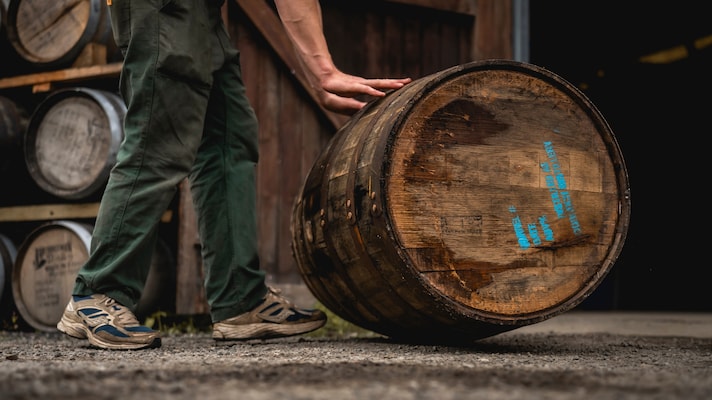
The problem is that whisky needs time: at least three years to be legally called Scotch, often ten or more to become a premium product. The casks filled in the euphoria of those years are now reaching maturity, ready to be bottled and sold. But the market that welcomes them, in the meantime, has changed. In the space of a decade, maturing stocks have grown from less than 400 million to approximately 1.4 billion liters, the equivalent of over 150 million standard cases: an enormous quantity, enough to cover approximately three years of global consumption alone: enough to cover three years of current consumption alone. A case that has become a symbol of this situation is that of the Holyrood Distillery in Edinburgh, opened in 2019 with an investment of nearly seven million pounds, and which in the spring had to indefinitely shut down its two large copper stills, despite still having thousands of casks ready to sell.
The Reasons Behind the Crisis
There is no single cause behind this crisis, but rather a combination of factors that came together almost simultaneously, turning a slowdown into a real shock for the sector.
- American tariffs. The United States represents a large market share for whisky, especially Scotch whisky. In April 2025, Washington imposed a 10% tariff, which caused exports to the US to plummet by around 15%. Although the tariffs were abolished in July 2026, the year of lost sales has taken its toll, and much unsold product remains in warehouses.
- The cooling of China and the premium segment. For a decade, the industry focused entirely on "premiumization," the idea that consumers would spend more and more on increasingly valuable bottles. This rush has stalled: single malt exports have declined, with significant repercussions in key markets like China and France, and a sharp contraction in flows to the commercial hub of Singapore, a sign that the allure of rarity is no longer enough to justify ever-increasing prices.
- Tax pressure in the UK. At home, excise duties on alcohol have increased by over 17% in three years, compounded by new packaging taxes and increased compliance costs. Scotch whisky thus finds itself competing with its own government for an increasingly smaller share of British consumers' budgets.
- Changing habits among younger generations. Global alcohol consumption is declining, and younger generations prefer other beverages, other social occasions, and other rhythms. It's often said that a generation has stopped drinking, but while this is partly true, it's important to keep in mind that today's—and tomorrow's—consumers have less disposable income to spend on a bottle costing tens and tens of pounds. Finally, one of the most impactful factors cannot be ignored: the growing attention to healthy and moderate lifestyles, which affects most age groups, not just the youngest.

Faced with such a complex set of challenges, not all distilleries are facing the same risk. The two industry giants, Diageo and Pernod Ricard, together control more than half the market and can afford to wait for the situation to stabilize. Those truly at risk are small, independent producers: according to some industry estimates, up to a quarter of Scotland's approximately 160 distilleries could be sold off in the coming years, while increasingly cautious banks and foreign investors, already hungry for opportunities, are closely watching any sign of trouble.
India's (Almost Saving) Role in The Sector
There are, however, some reasons for hope. India, already the world's leading whisky market by volume, could soon surpass the United States in value as well: a new trade agreement with the United Kingdom has halved tariffs on Scotch whisky and plans to reduce them further by 2036. Considering that the Scottish spirit currently represents just 3% of the Indian market, the margins for growth remain enormous. It may not be enough to quickly empty warehouses as full as they have ever been, but it is perhaps a sign that the lake of Scotch whisky may be ebbing again.
;Resize,width=767;)
