Some call it the “Georgian pizza”, some a focaccia and some a cheese bread: literally, khacho means cheese and puri bread, but, in fact, the same etymology would not seem to be enough to describe khachapuri, the Georgian national dish, which in recent years has seen itself cross the borders of the Caucasus and arrive in the U.S., where it has now become part of the great universe of street food, perfectly at home among those simple and inexpensive foods that are deeply linked to the culture of a country.
Born as a festive and religious food, khachapuri is a staple in bakeries across Georgia (and beyond) as well as in small towns. Its origins are not traced back to a single region, as evidence of this specialty has been found both along the coast and in the mountains. Khachapuri has even become a tool for economic measurement: since 2010, the ISET Policy Institute in Tbilisi has calculated the so-called Khachapuri Index every month, inspired by the more famous Big Mac Index created in 1986 by The Economist magazine. The idea is to monitor inflation and Georgians' purchasing power by measuring the cost of its ingredients. All that's left is to learn more about it.
What is Khachapuri?
Anyone who has tried it will hardly forget it: khachapuri is a gastronomic pleasure much loved by Georgians themselves, capable of bringing into the present (and also into the future) the most traditional soul of a people who for many centuries based their economy on pastoralism, livestock farming and dairy products.
It's no coincidence, in fact, that this stuffed bread may have been conceived as a way to use up surplus cheese, thus having it available for a longer period of time. A peasant ingenuity useful for survival and to avoid wasting food. After all, the basic ingredients of khachapuri are few and easy to find: flour, water or milk, salt, yeast, and sometimes vegetable oil for the dough (which can be thick or thin), while the filling features two local cheeses, to be used together or separately: sulguni, a stretched curd cheese made with cow's milk, buffalo milk, or a blend of cow and goat's milk, pleasantly salty (and sometimes smoked), and imeruli (which takes its name from the central region of Imereti), a softer, almost spongy, and delicate cow's milk cheese.
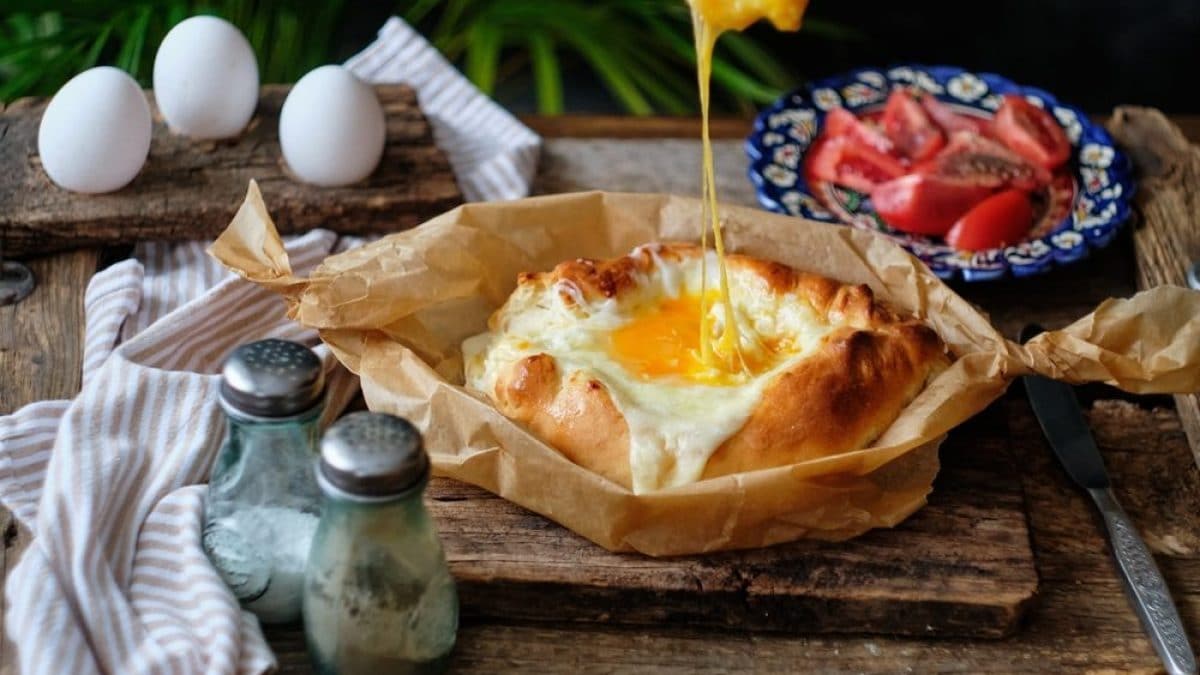
In Ajaruli Khachapuri (one of the most popular variations), a raw egg is added to the cheese before baking, so that the egg partially cooks during preparation. Once ready, the egg is mixed with the warm cheese to obtain a creamy consistency.
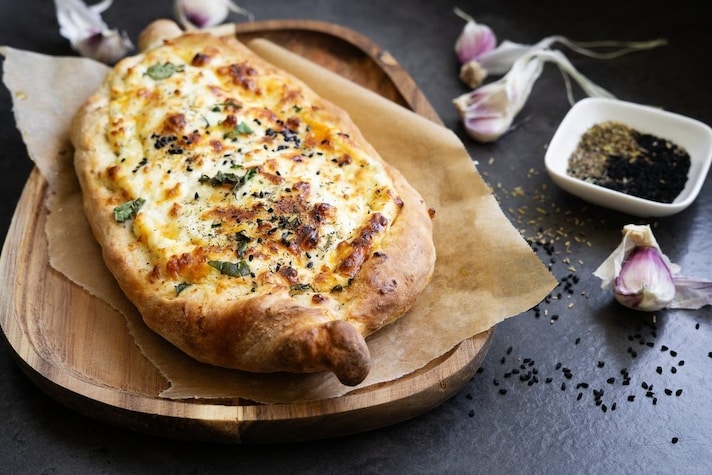
Abroad , since they're hard to find, mozzarella, feta, primosale, and stracchino are used instead, which are similar in flavor and texture. The whole thing is baked in the oven (once upon a time, these were only wood-fired ovens), creating a treasure chest with a substantial, stringy center.
The Most Famous Regional Variations of Khachapuri
But how is khachapuri made? One of its most fascinating aspects is its ability to change shape and flavor without losing its identity. In fact, there isn't just one recipe or version, but multiple interpretations that reflect the area of origin and family traditions.
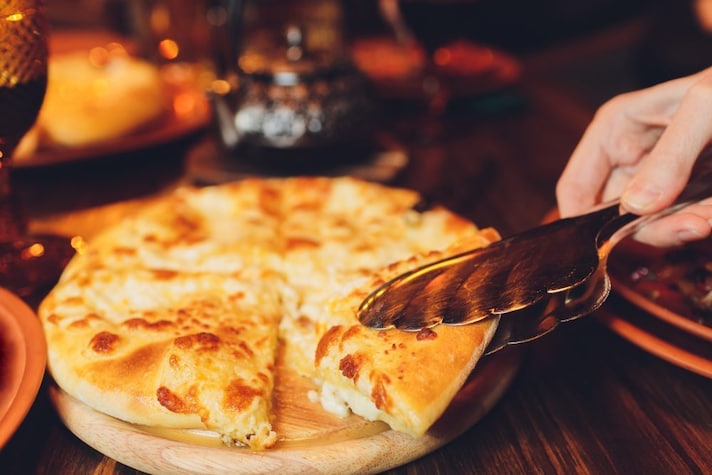
There's no doubt which is the most famous in the world, thanks to its captivating, delicious, and vaguely "playful" aesthetic. We're talking about the Adjaruli khachapuri, typical of Adjara, a region located in the southwest, overlooking the Black Sea. It looks like a boat, with the edges rolled inward, containing a filling of both melted cheeses. Once removed from the oven, it is garnished in the center with a raw fried egg and a knob of butter: when contacted with the heat, it creates an irresistible creamy mixture in which to dip the crust. A particularly scenic dish that can be made with feta and mozzarella, choosing the fillings you like most, for example with tomatoes, mushrooms, and chives depending on the season. The variant that is considered the most popular in the country – the one, for example, that is used as a reference for the aforementioned Khachapuri Index – is the Imeruli khachapuri: it has the traditional appearance of a round flatbread (and this is where the similarity to pizza comes into play), with two discs of dough simply enriched on the inside with the eponymous cheese, overlapped and sealed before being baked.
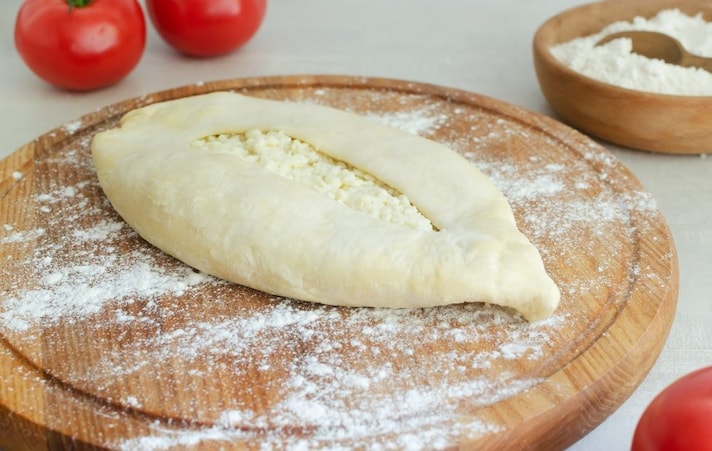
From the historic province of Mingrelia, also known as Samegrelo, comes Megruli khachapuri. This is in the northwest of the country, where the bread, always round, is even richer in cheese, as it is placed both inside and outside the dough, creating a golden, crispy, and stringy surface. In Ossetia, Khabidzgina khachapuri is filled with potatoes mashed with butter and cheese, like a sort of compact puree, while in the mountains of Svaneti, cheese is accompanied by spring onions in the Svaneti khachapuri.
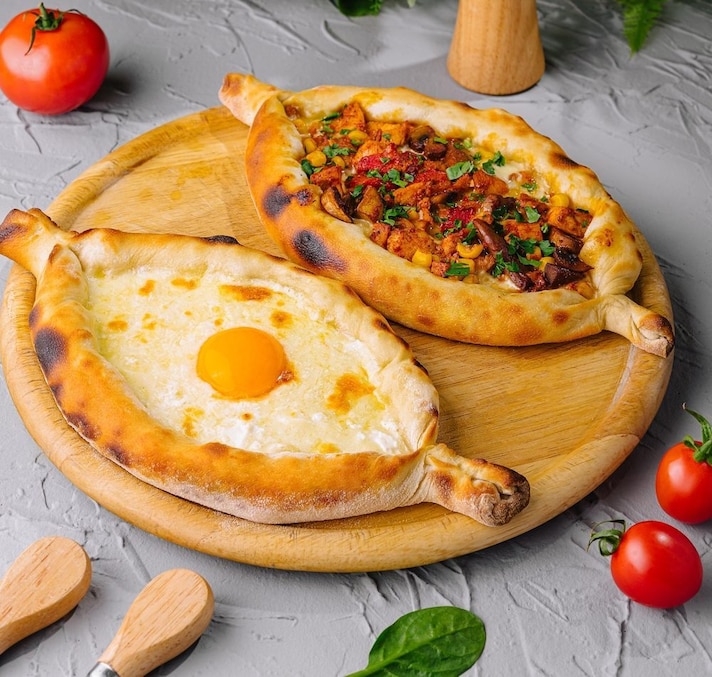
Three other variations on the theme deserve special mention: the first is called Gurian Khachapuri and is characterized by being crescent- shaped, filled with whole hard-boiled eggs and eaten once a year during the Orthodox Christmas celebrations; the second is Penovani khachapuri, with puff pastry replacing the leavened dough; the third and last is Mokhrakuli khachapuri, which is not baked, but fried in a pan, making it quick and easy. They are all worth trying.
;Resize,width=767;)
