Beautiful, delicate, elegant: there is no cake with such regal appeal as the princess cake. This magnificent pastry, characterized by its many layers, domed shape, and pastel-colored marzipan coating, is a Swedish specialty dedicated to three royal highnesses: Margaretha, Märtha, and Astrid, the daughters of Prince Carl of Sweden and therefore granddaughters of King Gustaf V of Sweden. In their honor, about a century ago, what has become one of the most beautiful and iconic cakes in the country was created, so much so that it is estimated that over half a million are sold each year throughout Sweden; it is so beloved that it has inspired the creation of a dedicated celebration, prinsesstårtans vecka, literally “princess cake week.”
Soft, colorful, and delicious, princess cake, or prinsesstårta in Swedish, seems to have come straight from a fairy tale or from the ancient noble palaces of Bridgerton. It's no surprise, then, that it has enjoyed great success even outside Scandinavia, winning over gourmands and romantics with its delicate aesthetic and enveloping flavor. And the story of how it was created, as if that weren't enough, is as fairytale-like as its appearance: here is the story of the birth and spread of princess cake.
What is Princess Cake?
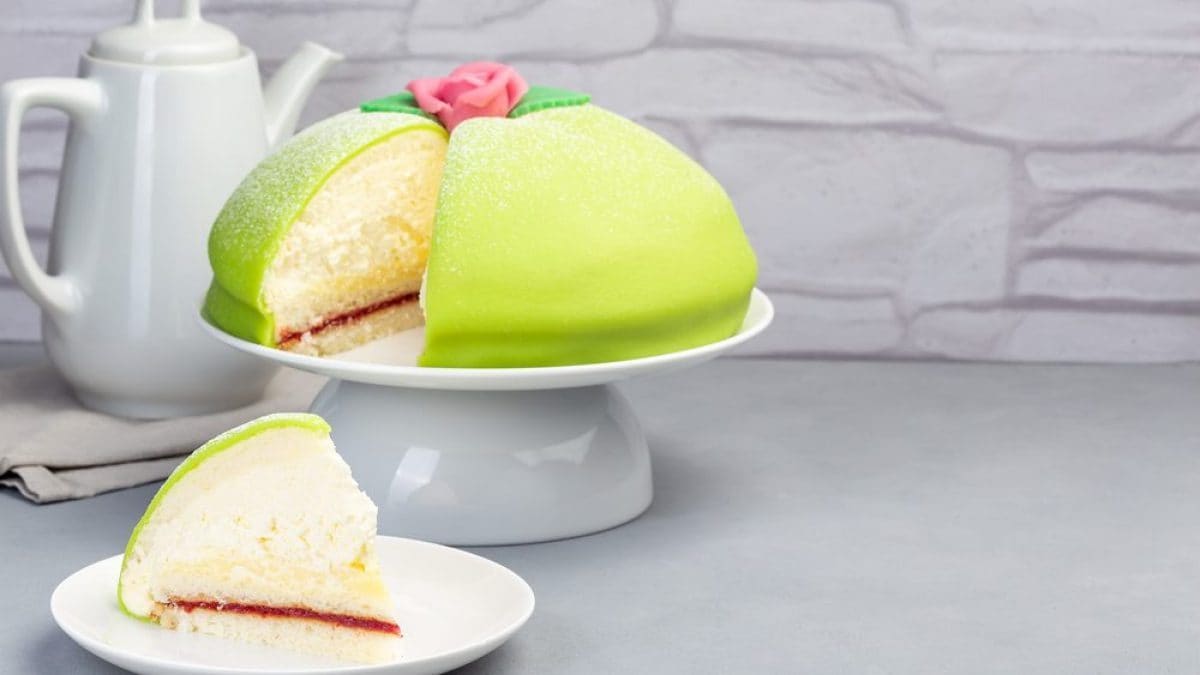
Prinsesstårta, known outside of Sweden as “princess cake,” is a traditional Swedish dessert famous for its elegant appearance and distinctive green marzipan topping. It is a layered cake made of soft sponge cake, filled with custard and generously topped with whipped cream; in more modern versions, it is often enriched with a layer of jam (usually raspberry) to balance the overall sweetness. The distinctive feature of princess cake is its domed shape, obtained by molding the cream, and the final marzipan coating, which is spread thinly to create a smooth and even surface, traditionally decorated with a small rose on top.

How did this beautiful cake, with its enveloping flavor and elegant appearance, come about? The creator of princess cake was Jenny Åkerström, a Swedish writer and gastronome who, around the 1940s, invented this refined dessert. Initially, however, its name was simply "green cake," due to the characteristic color of the marzipan shell. The original recipe dates back to 1948, in a reprint of the four-volume book entitled Prinsessornas kokbok (The Princess Cookbook), first published by Åkerström in 1929 with volumes of homemade and festive recipes. Curiously, the cake as we know it today was not mentioned in the early editions; according to the Swedish Council of Home Baking, the recipe first appeared in 1948 under the name, precisely, grön tårta, or green cake. It was the same structure that we today identify as the princess cake, even though (for some reason still unknown today) it disappeared from the 1952 edition.
Over the years, princess cake has become known in other countries as well, crossing national borders: it has taken hold particularly in England and the United States, particularly in San Francisco, linked to communities of Scandinavian origin who had a certain influence on the city's culture, also from a gastronomic point of view.
How is The Princess Cake Made?
Princess cake is a layered cake characterized by a harmonious combination of soft and creamy textures. The base is composed of one or more discs of light and airy sponge cake, often lightly moistened with syrup to keep it soft. A layer of velvety custard, made with milk, eggs, sugar, and vanilla, is spread over this, adding richness and depth of flavor. A generous layer of fluffy, lightly sweetened whipped cream is placed on top, helping to give the cake its characteristic rounded shape.

The entire cake is then covered with a thin layer of marzipan, traditionally green in color, carefully spread until it completely envelops the cake and seals its smooth, compact surface. The composition requires precision: the layers must be perfectly leveled and the cream delicately molded to create the characteristic dome, while the marzipan must adhere without creases, creating an elegant and uniform result. The finishing touches to make the princess cake as elegant as its name are a dusting of powdered sugar and a small marzipan rose placed on top.
Why is It Called "Princess Cake"?
The original princess cake recipe appeared in the 1948 edition of Jenny Åkerström's cookbook, but here the cake is simply called grön tårta, or green cake, due to its characteristic colored marzipan coating. How did the "princess cake" become known, and what do princesses have to do with it? It so happens that Jenny Åkerström also worked as a home economics teacher, and among her students were the three princesses Margaretha, Märtha, and Astrid, daughters of Prince Carl, brother of King Gustaf V. The story goes that the three girls fell in love with the cake's refined appearance and flavor. Furthermore, Åkerström's cookbook used the figures of her royal students for its promotion, so it became almost natural to dedicate the cake to the three young women.
What could represent them better than that beautiful cake, which the three of them also loved so much? The cake's final name was princess cake, and it soon spread throughout Sweden, becoming the country's most iconic dessert. The cake is such a symbol of Swedish national baking that it is celebrated annually during "Princess Cake Week" (Prinsesstårtans vecka), a delicious event that commemorates the history of the national dessert, but which has also become a charity initiative: for every cake sold during the holidays, a portion of the proceeds is donated to the Princess Victoria Fund, which supports children and adolescents with chronic illnesses or disabilities.

Princess Cake's Modern Preparation and Its Variations
The original princess cake recipe is still the most widespread and beloved, the one most commonly found in bakeries and restaurants throughout Sweden. Despite its close connection to the original, however, a whole series of variations and reinterpretations of the princess cake have emerged over the years. The most common change, or rather addition, is the inclusion of a light layer of raspberry jam in the bottom filling, which, in addition to adding a sweet-and-sour touch, makes the cake even more beautiful with the bright color of the jam.
A very popular and even more romantic variation is the operatårta, identical to the original in every way except for the color of the marzipan, which in this case is a deep shade of pink. There are also princess cakes made with yellow marzipan —in this case it is called prinstårta (prince's cake) or Carl Gustaf-tårta (Carl Gustaf's cake)—and more modern variations with unusual colors, such as white or even black. It is not uncommon to find reinterpretations inspired by the imagination of master pastry chefs: some modify the internal layers by introducing chocolate, coffee, or citrus-flavored creams, others add other decorations to embellish the marzipan dome, and still others increase the number of internal layers.
Princess cake has evolved over time and adapted to modern tastes, but at the same time it remains deeply rooted in Swedish home cooking tradition: many families continue to prepare it following handed down recipes, keeping alive that bond between elegance, simplicity, and conviviality that has made it such a success over time.
;Resize,width=767;)
