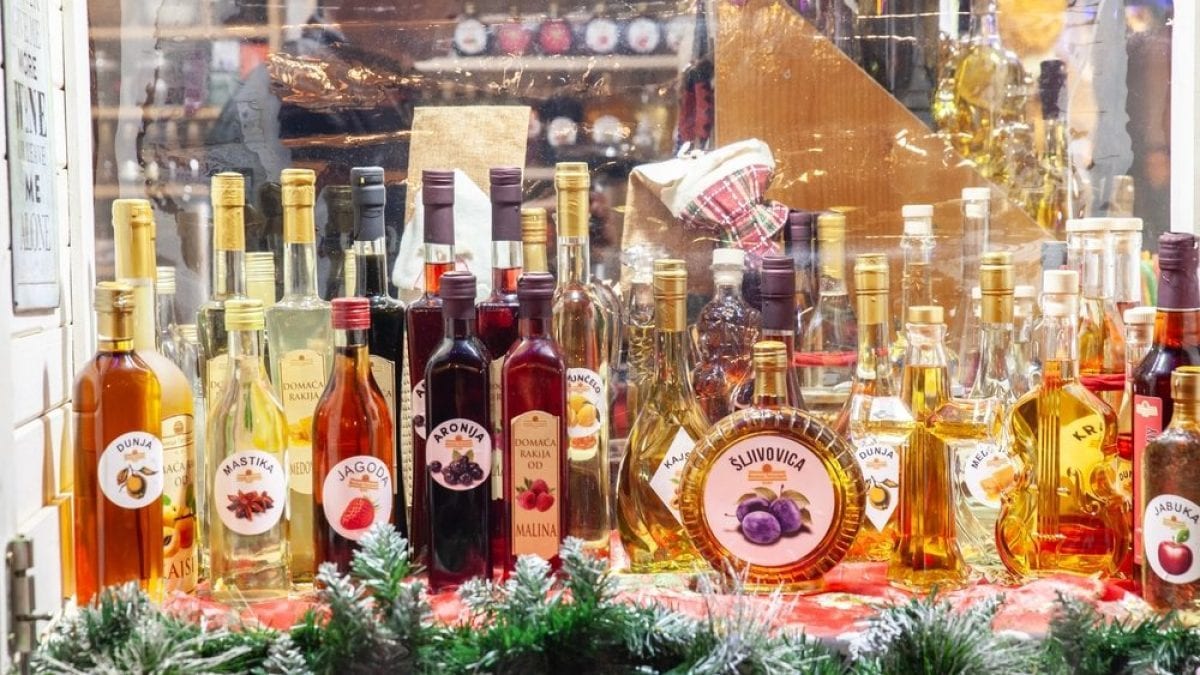
There's a drink that unites all Balkan countries: it doesn't matter if you're in Croatia or Albania, Serbia or Montenegro, wherever you are, you'll be greeted with a small glass of rakija. On paper, it's a fruit-based spirit typical of this area and very popular, but in practice, it's much more than that: it's a truly iconic drink, rooted in a long artisanal and home-made tradition (though industrial production also exists), something all Balkan residents look back on with pride.
There isn't a region, village, home, or family in the Balkans where there isn't at least a bottle of rakija ready to welcome guests, but also to accompany meals and mark the rhythm of the days and seasons, prepared strictly by hand by the "majstor rakije," the master craftsmen who jealously guard the secrets passed down through generations for making the perfect rakija. And that's not all: elders continue to maintain that rakija also has healing powers on a physical and spiritual level, so much so that it is the traditional funeral drink, capable of reconnecting the living with the souls of their deceased loved ones.
Also the protagonist of its own festival, the annual Rakia & Spirit Fest held in Sofia, Bulgaria, rakija is more than a drink: it embodies the spirit of the Balkans, the spirit of these places steeped in legend, of a land steeped in history and ancient traditions. Let's discover together the fascinating history and myths surrounding Balkan rakija.
What is Rakija?
Rakija is a typical Balkan spirit, specifically a fruit-based brandy. Most commonly, it's made from plums, but it can also be made from grapes, pears, figs, cherries, and many other fruits, depending on the production area. The key is that the raw material is first fermented and then distilled. Establishing a fixed recipe for rakija is practically impossible, as most production takes place at home, and each family has its own unique recipe.
However, there are some commonalities found in all the variations: the fruit must first be fermented for a few weeks, then cooked for 2–3 hours in large copper cauldrons, and finally the fermented mixture is brought to a boil. During the boiling process, the alcoholic vapors, cooling as they pass through the still, change state and transform into this precious and evocative beverage. Due to this particular double distillation process, traditional rakija is very alcoholic: it usually hovers around 40% ABV, but can reach 80% ABV in home-made production.

Rakija must have a fresh, fruity flavor, which is why it's called "wood-free," meaning it doesn't need to be aged in wooden barrels, which would otherwise give the drink the aromatic notes typical of this process. Aging is, however, permitted, but only in oak or mulberry barrels, and the addition of herbs after distillation is permitted. Typical of Albania, Croatia, Serbia, Bulgaria, and throughout the Balkans, including Montenegro and North Macedonia, rakija varies from region to region because each uses a different type of fruit, each choosing whether or not to refine the distillate, and flavoring it with additional ingredients—not just herbs, but also other aromas like honey or walnuts—to modify and personalize its flavor.
Generally, the most classic rakija is šljivovica, or plum brandy, among which the rakija from Gledić stands out. This Serbian region has always been renowned for the quality of its plums, used primarily to produce the famous brandy. Other well-known varieties of rakija include viljamovka (made from Williams pears), jabukovača (made from apples), orahovac (made from walnuts), and višnjevac (made from black cherries).
Rakija's History and The Legends That Accompany It
Tracing the origins and reconstructing a true history of rakija is very difficult due to its highly artisanal nature, which makes historical sources regarding its production very scarce. The first written records on the art of extracting the essence of the fruits are attested around the 7th century in a treatise by the alchemist Abu Beckr Mohamed Ibn-Zàkariaya el-Rhazi and its diffusion in the West is linked to the period of the Ottoman Empire, but usually to establish the birth of the Balkan distillate, reference is made to the period in which the word “rakija” began to circulate: it seems to derive from the Arabic term “al-rak”, which means to exude, to drip, and entered the languages of the southern Slavic peoples and those of the neighboring Albanians already in the period between the end of the 14th century and the dawn of the 15th.
This linguistic detail has long supported the two most popular hypotheses regarding the origins of rakija: that it originated in the late 14th or early 16th century. However, archaeological finds discovered between 2011 and 2015 have prompted historians to question this theory: two fragments attributable to a distillation system were found in the ancient fortress of Lyutitsa, in the far south of Bulgaria, and the same types of objects also emerged from excavations in the medieval fortress of Drastar, much further north. All three finds have been identified as dating back to the 11th century, thus suggesting that the distillation, and probably the preparation of rakija, are much older than previously thought, and that its original homeland may indeed be Bulgaria.

Like all traditional products so ancient and deeply rooted in the social fabric, rakija is also accompanied by its share of legends and beliefs that have attributed it with a variety of powers over the centuries. According to tales passed down in the Balkan region, in the past, rakija was believed to be the fruit of the esoteric doctrines of master alchemists, which is why the "spirit of fire" (one of its many nicknames) was attributed with miraculous powers. Traditional Balkan medicine has long believed rakija to be capable of curing all ailments, and it has long been used in medical and health therapies by local healers as an anesthetic, antiseptic, and antidepressant. However, it should be used in moderation: according to popular belief, excessive use of rakija could awaken its most evil demons. In this light, rakija appears almost like a sacred drink, and it is no coincidence that without a sip of this distillate there is no sealed agreement: in the Balkans, when a pact is made, it is not the signature that makes it effective but a firm handshake, looking each other in the eyes and a sip of rakija consumed together.
Balkan tradition also dictates that neither weddings nor burials can be celebrated without rakija: the drink, in fact, also has a highly ritualistic nature, linked to both the celebration of life and the celebration of death. At weddings, it is customary for the groom's father to offer small glasses of rakija to guests to bring happiness to the newlyweds, although it is during funerals that the spirit takes on its most ritualistic function.

In the case of funeral commemorations, rakija becomes a tool for connecting the living with the deceased, but by extension also with one's ancestors: toasting with rakija during a funeral is a way to honor the memory of the person who has passed away, but also to celebrate life and the happy moments that have been experienced and to strengthen the bonds between the living, offering support and comfort in a time of mourning. Furthermore, during funerals, it is customary to pour a little rakija on the ground before drinking it, as a gesture of respect and honor towards the deceased and all the spirits of ancestors who have passed away over time, but also to appease them and keep them benevolent towards the living.
How to Drink Rakija
A drink as traditional as rakija cannot help but have a series of traditional "rules" that accompany its consumption. Even in this case, the way in which the brandy is served and drunk varies depending on the country you are in, but generally everyone agrees on an unwritten rule: the older it is, the better it is. Generally in bars, rakija is served as an aperitif, in small glasses of 0.3 to 0.5 dl ("shots"), neat and at room temperature, often accompanied by mixed appetizers such as cured meats and cheeses; it is quite common to also find it warm during the winter, sweetened with honey or sugar, and chilled in the summer.

At a family level, however, toasting with a glass of rakija is an act of hospitality and generosity shown by the host towards their guest, which is why every home should always be stocked with brandy, preferably homemade from fruit from the family's own orchards. Even the preparation of rakija is a kind of family ritual, celebrated strictly in good company. In fact, it's customary to invite friends, relatives, and neighbors to taste the first drops of the ready-made brandy.
;Resize,width=767;)
