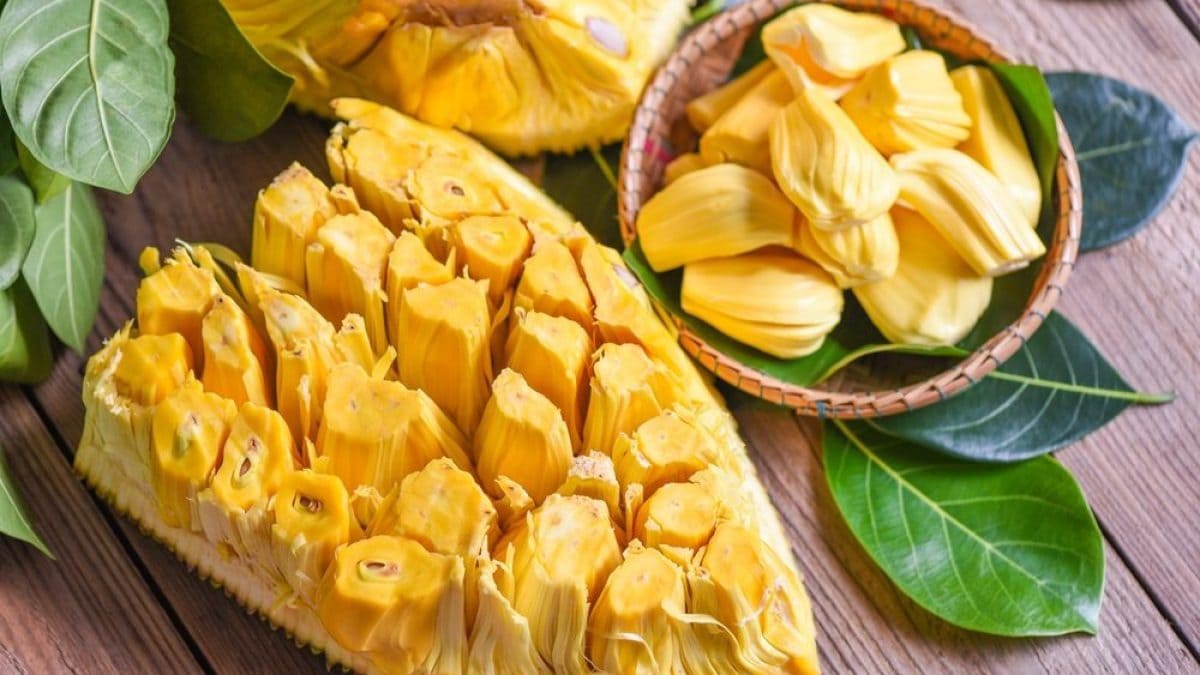
Imagine a fruit capable of reaching 40 kilos in weight and almost a meter in length. A fruit that grows directly on the trunk of a tree, as if suspended in enormous bunches. This natural wonder is called jackfruit, and in recent years it has become a true protagonist of the global gastronomic scene.
Native to India and Bangladesh, jackfruit is now cultivated in much of the tropical world, from Asia to Africa and South America. It's no coincidence that in India and Bangladesh it's considered the national fruit, a symbol of abundance and prosperity.
A Monumental Tree
The jackfruit tree, whose scientific name is Artocarpus heterophyllus, is an evergreen that can reach up to 15–20 meters in height: it has a dense crown, oval, leathery leaves, and above all it bears the fruit directly on the trunk and main branches, a feature that makes it even more impressive to observe.
The fruit, however, is striking both for its size and structure: on the outside, it has a yellowish-green peel covered with hard, pointed growths; on the inside, however, it hides a surprising richness: dozens of fleshy arils, each wrapped around a large, edible seed.

One Fruit, Two Faces
What makes jackfruit unique is its versatility, because its flavor and uses change completely depending on its stage of ripeness.
- When unripe, the pulp has a fibrous consistency, similar to shredded meat: it has no strong flavor, so it easily absorbs seasonings. This is why in recent years jackfruit has become a true "vegan phenomenon": cooked with spices, sauces, or smoked, it is used to prepare dishes reminiscent of pulled pork, tacos, burgers, and vegetable curries.
- When ripe, however, it transforms into a sweet and fragrant fruit. The yellow pulp has a tropical flavor reminiscent of banana, mango, and pineapple, and is perfect eaten fresh or used in smoothies, ice cream, desserts, and jams.
The seeds also play an important role: rich in starch and protein, they are boiled, roasted or ground into flour, becoming a precious food in traditional kitchens.

Jackfruit's Properties and Benefits
Jackfruit isn't just curious about its size: it's also a nutritious fruit. It's rich in fiber, which is beneficial for intestinal health, and provides vitamin C and various antioxidants. It contains potassium, a mineral essential for fluid balance and blood pressure. The seeds, as mentioned, provide a good amount of plant-based protein.
In many tropical communities, jackfruit is considered a survival resource: it grows abundantly, requires little care, and its large, nutritious fruits can feed entire families.

A Cultural and Identity Symbol
Beyond its culinary significance, jackfruit also has a strong symbolic value. In India, Sri Lanka, the Philippines, and Indonesia, it is the protagonist of popular festivals, fairs, and religious traditions. In Bangladesh, it is the national fruit, celebrated not only as a food but also as a symbol of agricultural prosperity.
In recent years, with the spread of vegetarian and vegan diets, jackfruit has found new life in the West as well, becoming a “trendy” ingredient in ethnic and gourmet restaurants.

Breadfruit, Its More Sober Cousin
Alongside jackfruit, its closest relative, the breadfruit (Artocarpus altilis), is worth mentioning. Unlike jackfruit, breadfruit fruits are much smaller—usually between 1 and 3 kilos—and have firm, mealy flesh without distinct arils.

Its strength lies in its high starch content, making it a perfect substitute for bread or potatoes. Baked, fried, or boiled, breadfruit has a neutral, nutritious flavor, and for centuries has been a staple of the diet of Pacific Islanders. It's no coincidence that it was planted near villages as a "survival " plant, always ready to provide an abundance of food.

Jackfruit and breadfruit are close relatives, but they tell two different stories. The former is striking for its imposing size, its two faces —sweet and savory—and its ability to conquer contemporary cuisine. The latter, more discreet, has been a fundamental resource for oceanic communities, a precious ally against hunger. They share the same botanical origins, the ability to provide simple and sustainable nourishment, and their role as "human-friendly" plants. Two examples of how nature, in different forms, has been able to offer humanity extraordinary food and culture solutions.
;Resize,width=767;)
