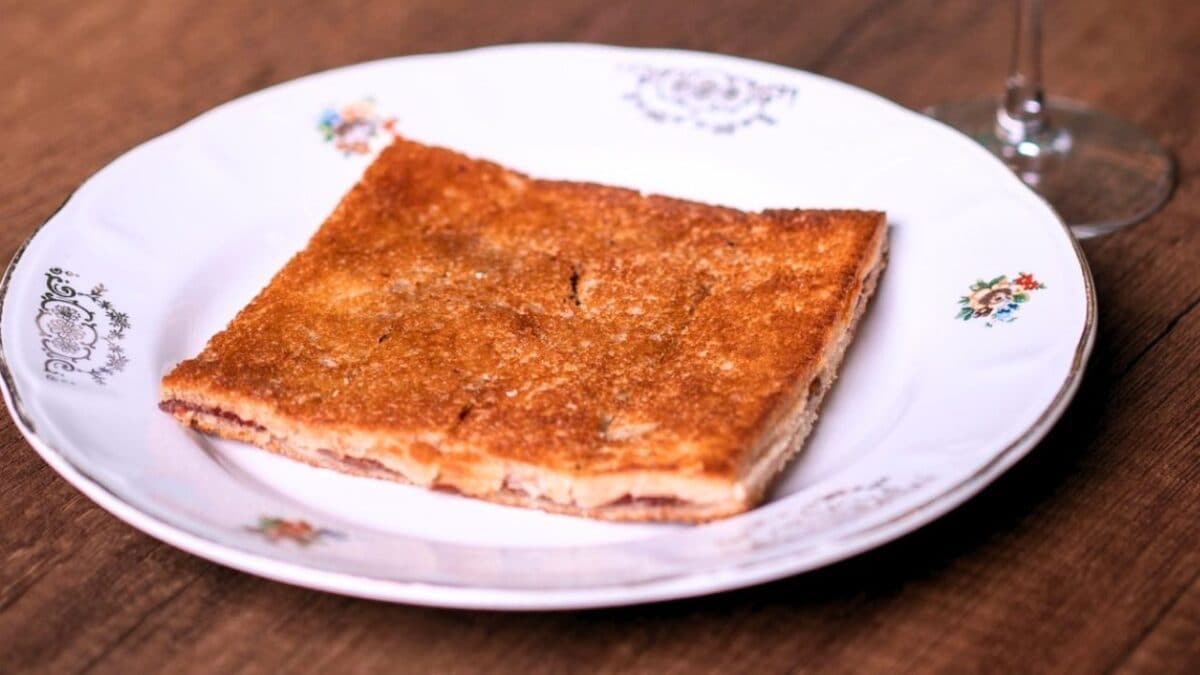
If you walk into a bar in Catalonia and order a bikini, probably no one will think of a bathing suit. Instead, you'll get a hot sandwich, made with two slices of sandwich bread, cooked ham, and cheese, grilled until golden and crispy. A simple, almost banal sandwich, which in much of Spain is called a sandwich mixto, but in Catalonia it has a much more curious name.
Why, in fact, is it called a bikini? The answer has nothing to do with the shape of the sandwich, with the fact that it is cut into two triangles, or with the famous swimsuit. To find out, you have to go back to 1950s Barcelona, a Spain still marked by the Franco dictatorship, and above all, enter a dance hall called precisely that: the Bikini Room.
What is The Bikini and Where Did It Originate?
It's 1953. The Spanish Civil War has been over for almost fifteen years, and Francisco Franco is still firmly in power. The country bears the scars of the postwar era: the 1940s were characterized by economic autarky, shortages, rationing, and international isolation. For this reason, at the beginning of the 1950s, Spain is still far from the prosperity that is beginning to spread to other Western European countries. However, 1953 is also a year of change: Spain is slowly beginning to emerge from its international marginalization and look abroad.
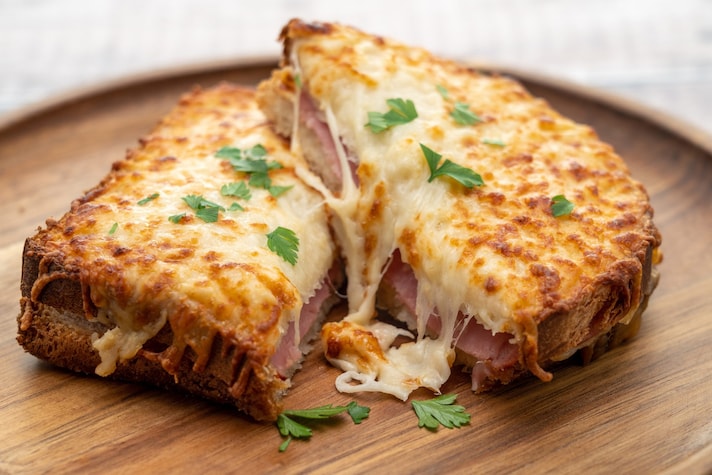
It is precisely in this context, between openness and rigidity, that a decidedly modern venue for the time was born in Barcelona: the Sala Bikini. Opening onto Avinguda Diagonal, the venue offered music, dancing, food and outdoor spaces: among its attractions was also a minigolf course, considered a real novelty in the Barcelona of those years. The venue aimed to have an international and cosmopolitan image, recalling above all the famous and glamorous American clubs. Among the gastronomic offerings, however, appeared a sandwich, inspired by a French specialty (which we know very well today): the croque-monsieur. This French preparation, which appeared in Parisian cafés as early as the beginning of the twentieth century, is based on ham and cheese and is traditionally au gratin, often with béchamel sauce. The one served at the Sala Bikini is a simpler version, suitable for a bar kitchen: sandwich bread, cooked ham and cheese, all heated on a griddle: it was precisely the future bikini.
Why the Croque-Monsieur Became a Bikini
At this point, a question arises spontaneously: if the Sala Bikini sandwich was inspired by the French croque-monsieur, why not simply call it that? The answer has to do with the particular historical period: Spain was still under the Franco regime, and the public use of foreign terms was restricted and not particularly favored. According to the most widespread reconstruction, the sandwich was therefore not presented by its French name, but as el bocadillo de la casa, "the house sandwich."
A generic name, however, destined to be short-lived: the sandwich was a hit with the customers of the Bikini Room and began to become one of the establishment's recognizable specialties. When customers began seeking it out in other bars around the city, they ordered it by referring to the place where they ate it, asking for a sandwich "like the Bikini one" or "the Bikini sandwich." And this is where the normal mechanism of language kicks in: from the Sala Bikini's bocadillo de la casa, the sandwich becomes the Bikini bocadillo, and little by little, only the bikini remains. Its spread was gradual: first in Barcelona, then in Catalonia, where even today, asking for a bikini means ordering what in the rest of Spain is generally called a sandwich mixto.
Bikini Vs. Mixto Vs. Croque-Monsieur: Are They The Same Thing?
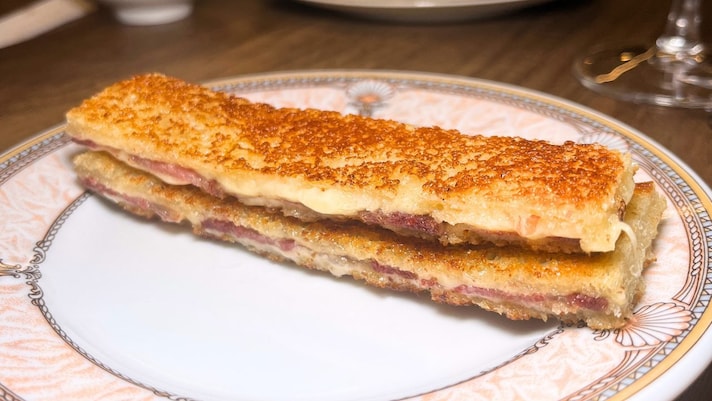
At first glance, yes, but the story is a little more complicated. The Catalan bikini was born as a reinterpretation of the croque-monsieur, but over time the two preparations have followed different paths: the traditional French sandwich can be prepared with béchamel sauce and is generally au gratin; the Catalan bikini, on the other hand, is much more basic. The classic version includes sandwich bread, cooked ham, and cheese, with the bread optionally buttered and then toasted on a griddle: the result should have a golden and crispy surface, while the cheese inside melts and the ham warms.
Even the comparison with the mixto sandwich is mainly a question of name and local tradition: in much of Spain, people order a mixto, while in Catalonia the term bikini has become more popular. The basic preparation, however, is essentially the same: bread, ham, and cheese toasted together.
;Resize,width=767;)
